One Camera, One Lens, and 12 Hours Waiting for Sunrise with the Sony 20mm f1.8
I don’t get out camping much in the summer. I usually just take my kids out a couple of times, but beyond that, I tend to avoid it. I don't like the busyness, the heat, or the crowds. But it’s mid-September now. The wind is picking up, the temperature is dropping, and the nights are finally drawing in. We are looking at about 12 hours between sunset and sunrise. It’s time to get back out there, this time, with just a Sony 20mm f1.8 lens. Here’s the film I made…
Shot entirely with the Sony 20mm f1.8 lens - Buy it here on Amazon, currently on offer.
My last YouTube video was in February. This week, I headed up into the Shropshire hills to shoot a new wild camping video. I wanted to create an old-school, back-to-basics, silent cinematic film.
I’ve released two videos from this trip. The first is a behind-the-scenes vlog detailing the reality of the camp, the weather, and the gear. You can watch that here: I’m Back! Filming a cinematic wild camping film in Shropshire
The second video is the main event. It’s a purely cinematic wild camping film titled 12 Hours Waiting for Sunrise. There is no talking. No presenting. Just the ambient reality of waiting out a windy winter night on a hill. If you want to understand what it actually feels like to sit through the dark and wait for that orange ball of warmth to finally appear over the horizon.
The Gear: Stripping It All Down
Those of you familiar with my commercial work know that coming out light is highly unusual for me. Over the last 17 years shooting outside broadcasts and live sports, I’m used to heavy technical logistics. Blimps, drones, tracking vehicles, gimbals, remote heads, and multi-camera arrays. Even on personal trips, it’s quite common for me to haul three, four, maybe even seven cameras up a mountain when you factor in the gimbals, action cams, sliders, drones and heavy time-lapse rigs.
This trip was different. This was one man, one camera, and one hill. In fact, for the first time in a very long time, I brought more food than camera gear. (And liked it!)
The entire visual language of this trip relied on a highly stripped-down setup: the Sony ZV-E1 paired strictly with the Sony 20mm f1.8 lens.
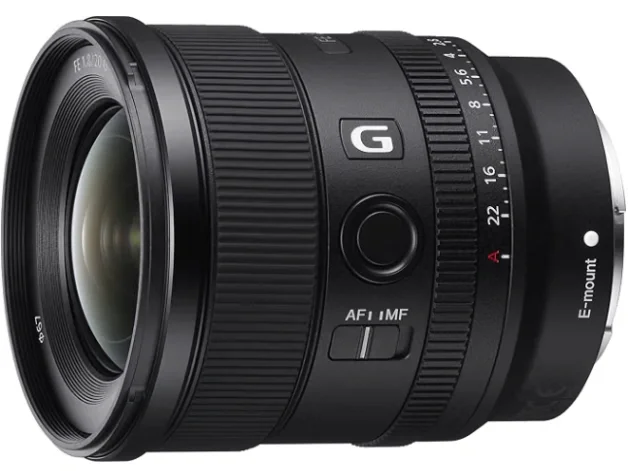
Sony 20mm f1.8 Lens Review: The One-Lens Challenge
Since this entire cinematic film was shot on a single focal length, it makes sense to break down exactly how this piece of glass performs in the field.
The Sony 20mm f1.8 for Sony FE cameras is a small, lightweight prime lens, coming in at just under half a kilo (380 grams). It’s expensive—typical Sony pricing—at around £950.
You can pick it up here on AMAZON AFFILIATE LINK
Build and Handling It has an aperture ring that comes with a click switch, allowing you to use it in either clicked or unclicked mode. I love this feature. The clicks are nice and firm, ensuring that the aperture ring stays exactly where you set it. It makes it very difficult to accidentally knock it out of place while pulling the camera in and out of a tight backpack. Don’t want the click for smooth video pulls? Just flick it to unclicked mode, and it becomes lovely and smooth again.
For those wanting to use auto aperture—you absolute weirdos—you can turn the aperture ring all the way round to auto mode, and it’s a solid, firm click in and out. You won’t accidentally slip into or out of auto mode.
Optical Performance It has a short minimum focus distance of just 19cm, which is perfect for those epic near-wide shots I use constantly in my content to establish scale. It is incredibly sharp, exactly as you would expect from Sony G glass. There is a bit of focus breathing, but I really don’t see that being an issue with a 20mm field of view.
I have noticed a small amount of barrel distortion and vignetting, but nothing concerning. I’m not a pixel peeper. The overall image quality with this lens is outstanding; I’m just pointing out the flaws so you know they are there if you go looking for them.
There is no in-lens stabilisation. Unfortunately, that’s the trade-off. But again, that’s rarely an issue at 20mm. I’m perfectly happy to take the smaller form factor and lighter weight over internal stabilisation.
The Flaws: Flaring and Weather Sealing The biggest issue I’ve had with this lens is flaring, which completely ruined a couple of time-lapses for me.
Then there is the weather sealing. Sony doesn't explicitly claim this is a weatherproof lens. They never really do. They say it’s "moisture and dust resistant"—whatever that means. Let me tell you about my extreme experience with it.
I took this lens up into the Welsh winter mountains for three days to shoot some timelapse sequences. It did okay during the day, but after leaving it out on the edge of a cliff overnight in humid, frozen -10°C conditions, it developed an internal mist spot right at sunrise. It was minor, but it effectively ruined my sunrise timelapse sequence.
I don’t want to be too harsh. It was an extreme test, and those conditions are likely beyond what Sony designed it for. But that is the reality of my experience. Beyond that specific failure, the build quality is fine, relying on that typical, sturdy Sony G plastic construction.
Overall, it’s a great lens and one that I frequently take out for shooting landscapes and timelapses. It’s small, light, and easy to chuck in a bag. I am a massive fan of the "near-wide" style of framing, and this lens delivers that look perfectly.
The Camp: Shropshire and the Hilleberg Soulo
This trip, though, the original plan was to head up into Snowdonia. I have a new view of Tryfan I am keen to capture, but the wind was simply too strong for the kind of precision I wanted. So, I defaulted to my stomping ground: the Shropshire hills.
It was a gusty day, blowing a constant 30 to 40 mph on the summit. The wind chill knocked the 16°C ambient temperature right down into the low teens, forcing me to abandon my shorts and immediately pull out the trousers and the down jacket. The shock to the system after a mild summer was real. What a pussy.
I dropped down the lee side of the hill just to get out of the wind and brew up some Colombian Supremo in the Aeropress. Looking out from that spot, the view across the valley is brilliant—Caradoc dead centre, The Lawley behind it to the left, and the Wrekin near Telford way out in the back. I’ve spent a lot of time on those summits, catching some incredible winter cloud inversions up there.
Because I knew the wind was going to be brutal, I packed the Hilleberg Soulo. I wouldn't usually bring a Black Label tent out into Shropshire. I normally run with my MSRs, which I really like. But knowing the forecast, I wanted the absolute security of a tent built for storms. Pitching it solo in 40 mph gusts was a bit of a faff—I’ve only rigged it a handful of times—but once it was up and locked down, it was a fortress.
The Downtime: Dostoevsky and Deadlifts
When you are out for a 12-hour winter night, you have a lot of time to kill. Once the camera is rolling on the ambient wide shots, you sit, you wait, and you think.
I brought out an old 1942 hardback copy of Crime and Punishment by Fyodor Dostoevsky. It’s my favourite novel, and arguably the greatest ever written. I could have bought a cheap paperback off Amazon for a fiver, but I spent a bit more for this old, rustic copy. It smells right, and it feels right in the hands when you're sitting in a tent in the cold.
The book is a psychological breakdown of crime, punishment, and the severe shortcomings of nihilism. The main character, Raskolnikov, commits a murder early on, rationalising that if there is no God and nobody is watching, he can get away with it and even use the stolen money for a supposed greater good. He quickly finds out that you can't simply bypass the objective moral law. The rest of the book is a brutal study in self-punishment before the authorities even catch up to him. It’s a heavy read, but it perfectly suits the isolation of a windy hillside.
Between reading and drinking electrolytes, dinner was a massive affair. I’m currently balancing a highly conflicting hybrid fitness routine. I have a goal to run a 5k in under 20 minutes, but I refuse to get too skinny doing it. I want to maintain the heavy strength work. In the past, I've deadlifted 245kg and run a 17.5-minute 5k, but right now I am fighting for that middle ground. I’m hitting the running hard while trying to keep my deadlift around the 200kg mark.
To fuel that, you have to eat big. Dinner in the tent was 12 beef meatballs mixed with high-protein smoky Mexican chilli con carne (complete marketing bollocks, but it tastes good), alongside an entire 1500-calorie sourdough loaf.
I’ve also started stretching recently. After years of ignoring flexibility, I had five different people ask me about my stretching routine in a single week. I took it as a sign. I’ve been trying out Pilates and some deep stretching routines from a guy called Sean Vigue on YouTube. The yoga was okay, but it came with too much spiritual baggage for my liking. The Pilates, however, is brutal and effective. Sitting cross-legged in the tent waiting for the sun to rise, I definitely felt the benefit.
10 Minutes of Magic
The night itself was incredibly windy, but otherwise quiet. Around midnight, the clouds broke just enough to reveal an absolutely insane view of the Milky Way, which made the cold entirely worth it.
I woke up at 6:38 AM to beautifully moody, heavily clouded skies. These are my absolute favourite conditions. A clear blue sky is boring. You want thick clouds with just a tiny gap on the horizon for the light to punch through.
After 12 hours of waiting, the sun finally crested. We got exactly ten minutes of epic, high-contrast magic before the clouds swallowed the light again. That brief window is what the entire trip was for. It’s all captured in the cinematic film.
If you are a commercial buyer or a creative looking to use this kind of high-fidelity, quiet 4K footage in your own projects, you can now license my ambient films in full, including the raw sound design. All the details are available here: chrishomer.uk/ambient-films.
Go watch the film, let me know what you think of the single-lens approach, and I’ll see you on the next one.